
GEO vs SEO: The Difference That Will Define E-commerce in 2026
SEO optimizes for search engine ranking. GEO optimizes for AI recommendation. Same catalog, two entirely different games — and the rules just changed.
Generative Engine Optimization (GEO) is the practice of making your products readable, comparable, and citable by AI models — so that when ChatGPT, Gemini, or Perplexity answers a shopping question, your product is the one it recommends.
SEO is about ranking in a list of links. GEO is about being the answer.
The Core Difference
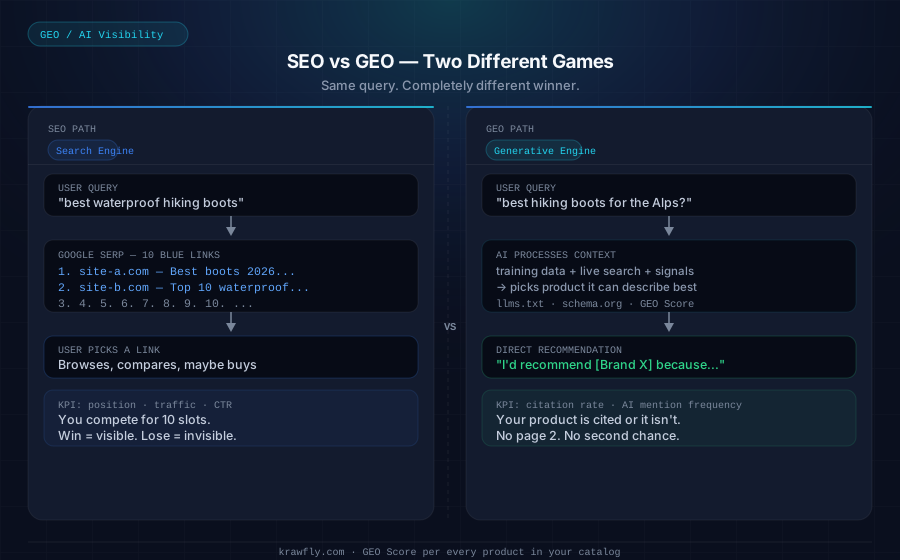
When a user searches “best waterproof hiking boots” on Google, they get ten blue links and choose one to click. Your job is to be in those ten links.
When the same user asks ChatGPT “what waterproof hiking boots should I buy for the Alps?”, they get one answer — a direct recommendation with reasons. Your job is to be that recommendation.
| SEO | GEO | |
|---|---|---|
| Target | Search engine crawlers | AI language models |
| Output | A ranked link in a list | A direct recommendation |
| Signal | Backlinks, keywords, page speed | Product clarity, semantic context, citations |
| Metric | Ranking position, organic traffic | AI citations, recommendation frequency |
| Timeline | Months to years | Weeks to months |
| Who wins | Sites with authority and backlinks | Products AI models understand best |
Why GEO Is Not Replacing SEO
SEO is not going away. Google still processes over 8 billion searches per day. For the foreseeable future, you need both.
Think of it this way:
- SEO makes your store findable when humans browse
- GEO makes your products recommendable when AI agents answer
The stores that will win in 2026 are the ones that treat both as distinct disciplines with distinct signals and distinct metrics.
What GEO Signals Look Like
A product optimized for search engines has a keyword-rich title, a description with volume terms, and alt text on images.
A product optimized for AI recommendation has:
- A clear entity identity — what this product is, who it is for, what problem it solves
- Comparison context — how it relates to alternatives (materials, specs, use cases)
- Citation-ready attributes — specific claims AI models can quote confidently
- Structured signals — schema markup, llms.txt, metafields that AI crawlers can parse
The GEO Score
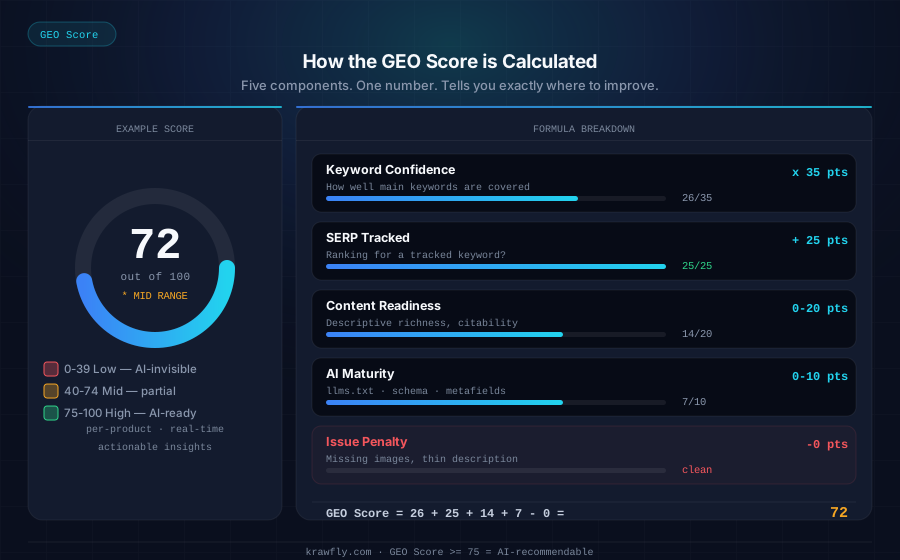
At Krawfly, we measure GEO readiness with a single score per product: the GEO Score. It combines keyword confidence, SERP tracking, content readiness, AI maturity, and a penalty for structural issues. A product with a high GEO Score is one an AI model can confidently recommend.
The formula:
GEO Score = (keyword_confidence × 35)
           + (serp_tracked ? 25 : 0)
           + content_readiness (0–20)
           + ai_maturity (0–10)
           − issue_penalty
A higher GEO Score indicates a product with stronger AI-readability signals. A low score highlights where context, structure, or content gaps are most likely to reduce visibility with AI systems.
How to Start with GEO Today
You do not need to rebuild your catalog. Start with three things:
- Create an llms.txt file — use the free Krawfly generator to create one in seconds
- Fix thin product descriptions — AI models skip products they cannot describe confidently
- Add structured data — schema.org Product markup gives AI crawlers parseable signals
For stores with large catalogs, Krawfly automates all of this: scanning each product, generating optimized signals, publishing them to Shopify, and tracking how often AI models cite your products over time.
Frequently Asked Questions
Is GEO only for e-commerce? No, but e-commerce stores have the most to gain. When AI models handle shopping queries, product recommendations are the highest-value output. A direct AI recommendation can drive meaningful traffic without requiring a user to click through a list of search results.
Do I need to choose between SEO and GEO? No. Most GEO improvements (clearer product descriptions, structured data, better entity context) also benefit SEO. Treat GEO as an additive layer on top of your existing SEO work.
When will GEO matter as much as SEO? AI-powered search already accounts for a significant and growing share of product discovery queries. The inflection point is not in years — it is happening now.
Free Tool
Generate your llms.txt in seconds
Paste any website URL and get a free, structured llms.txt file following the llmstxt.org specification. No signup required.
Try the free generator →