
How ChatGPT Chooses Which Products to Recommend
When a user asks ChatGPT for a product recommendation, it does not browse your store. It uses signals, training data, and live search to construct an answer. Here is what that means for your e-commerce catalog.
When ChatGPT recommends a product, it is not opening your website and reading your product pages. It is constructing an answer from a combination of training data, retrieved search results, and structured signals — and your product either has enough context to be included in that answer, or it does not.
Understanding this mechanism is the first step to making your catalog AI-recommendable.
How the Recommendation Process Works
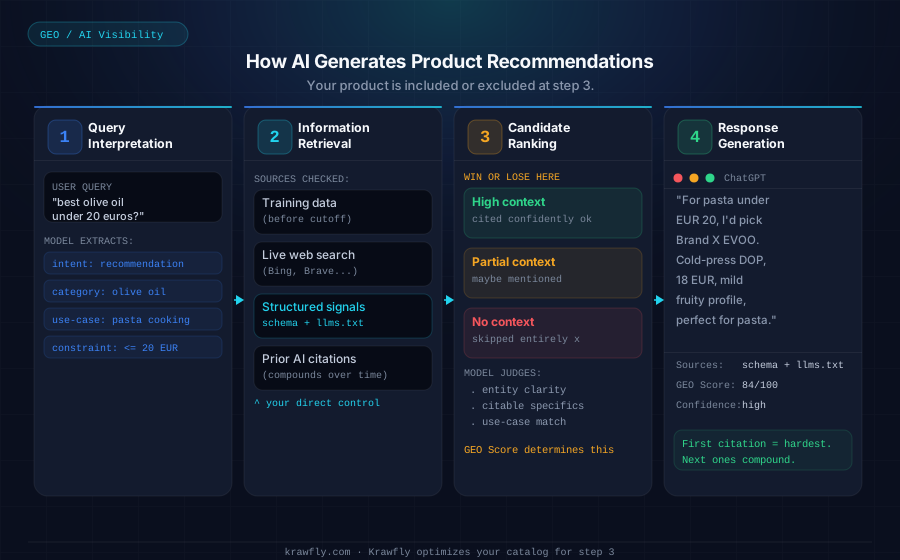
When a user types “what’s the best olive oil for cooking pasta under €20?”, here is what happens inside an AI model:
- Query interpretation — the model identifies intent (product recommendation), category (olive oil), use case (cooking pasta), constraint (under €20)
- Knowledge retrieval — it searches its training data and, if web search is enabled, live results for relevant entities
- Candidate ranking — it scores candidates by how well their known attributes match the query
- Answer generation — it picks the best match it can confidently describe and generates a recommendation with reasons
Your product gets recommended if the model has enough structured, accurate information to confidently describe it in the context of that specific query.
What Information AI Models Use
| Source | What it contains | Your control |
|---|---|---|
| Training data | Everything indexed before the training cutoff | Indirect — content you published before cutoff |
| Live web search | Real-time search results (Bing, etc.) | Your current SEO and page content |
| Structured signals | Schema markup, llms.txt, metafields | Direct — you control this completely |
| Citations from other AI answers | When AI models cite each other | Grows over time as you get recommended more |
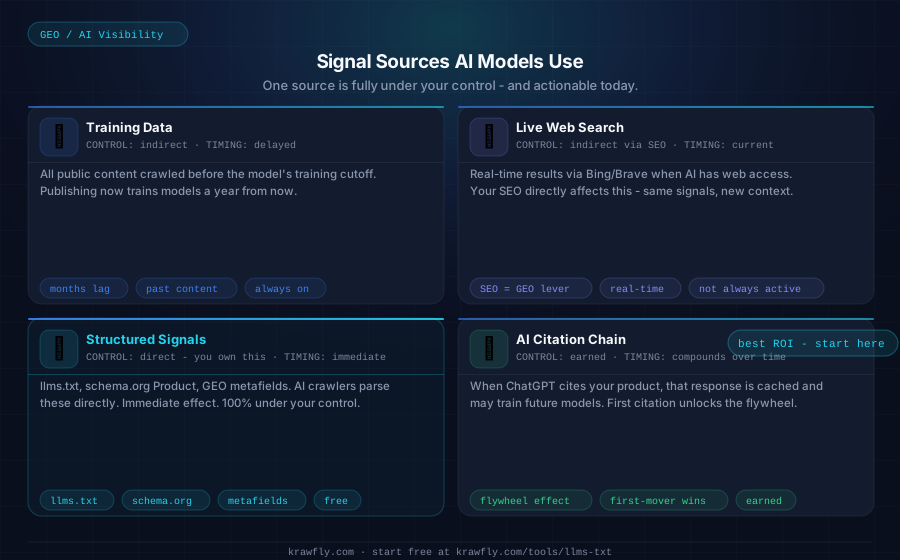
The key insight: structured signals are the only channel you control completely and immediately.
Why Most Products Get Skipped
AI models skip products for predictable reasons:
Vague descriptions — “High-quality product with great features” gives a model nothing to work with. It cannot cite quality claims it cannot verify.
No comparison context — AI models often answer in comparison mode (“A is better than B for X because…”). Products without clear differentiators get excluded from comparisons.
Missing use-case signals — a product description that does not state who it is for and what problem it solves cannot be matched to specific queries.
Weak entity definition — the model does not know what category your product belongs to, what its key specs are, or how it relates to competing products.
What Makes a Product AI-Recommendable
A product that gets recommended by AI models consistently has these properties:
Clear entity identity The product has a specific name, category, and set of attributes the model can parse. Not just “jacket” but “lightweight insulated jacket for alpine hiking, 3-season, 450g fill power down.”
Specific, citable claims “Waterproof up to 20,000mm hydrostatic head” is citable. “Great waterproofing” is not. AI models quote specific numbers because they are verifiable.
Use-case context Who is this for? What scenario is it best in? What does it solve that alternatives do not? The more specific, the better the match to niche queries.
Structured signals Schema.org Product markup, an llms.txt file that surfaces your key pages, and clean metafields that AI crawlers can parse without interpreting ambiguous prose.
The Citation Flywheel
Once an AI model recommends your product in an answer, that answer gets cached, shared, and used to train future models. The first recommendation is the hardest to earn — subsequent ones build on it.
This is why early movers in GEO have a compounding advantage. The stores that make their catalogs AI-readable now will be recommended more often in six months, and exponentially more in two years.
How to Check If Your Products Are AI-Visible
The fastest way to check is to ask ChatGPT or Perplexity directly: “recommend a [your category] from [your brand]” or “what is the best [product type] from [your brand]?”
If the model does not know your brand, returns generic answers, or recommends competitors, your AI visibility is low.
Krawfly provides a GEO Score for every product in your catalog — measuring keyword confidence, SERP context, content readiness, and AI maturity — so you know exactly where visibility gaps exist and what to fix first.
You can also start by generating an llms.txt for your store for free — it takes 10 seconds and immediately improves how AI models understand your site structure.
Frequently Asked Questions
Does ChatGPT browse my store in real time? Only if the user enables web browsing or uses a tool like Bing integration. Without browsing, it uses training data. With browsing, it fetches your current pages — which is why both training-time signals and live page quality matter.
Should I write product descriptions for AI or for humans? Both. Specific, structured, factual descriptions perform better with humans (higher conversion) and with AI models (better recommendations). The goals align.
Does product price affect AI recommendations? Yes, when the query includes a price constraint. Keep your prices accurate in structured data and schema markup so AI models can match your products to budget-specific queries.
How long does it take to see results from GEO optimization? Typically 4–8 weeks before measurable changes in citation frequency. Structural fixes (schema, llms.txt) take effect faster than content-level improvements.
Free Tool
Generate your llms.txt in seconds
Paste any website URL and get a free, structured llms.txt file following the llmstxt.org specification. No signup required.
Try the free generator →