
What is llms.txt? Format, Spec and What to Put in the File
llms.txt is a Markdown file at your domain root that maps important pages for AI tools. Here is the llmstxt.org format, what to include, and how it differs from robots.txt.
llms.txt is a plain-text file you place at the root of your website — at yourdomain.com/llms.txt — that tells AI language models exactly what your site is about, which pages matter, and how to interpret your content. Think of it as a robots.txt for AI engines.
Without an llms.txt, compatible crawlers have to infer your site from HTML, sitemaps and whatever they already know. With one, you publish a concise map you control. That is useful for discovery — it is not a ranking factor and it does not guarantee citations.
This page is the definition and spec. For whether the file moves AI visibility, read Does llms.txt actually help?. To create one, use the free generator.
Why ecommerce teams publish llms.txt
When a shopper asks ChatGPT “what is the best espresso machine under €300?”, the model does not browse your storefront like a human. Retrieval systems use compressed context: training data, live search, structured data, and — for some agents — files like llms.txt.
A clear map can reduce guesswork. Thin or missing product data still loses the recommendation.
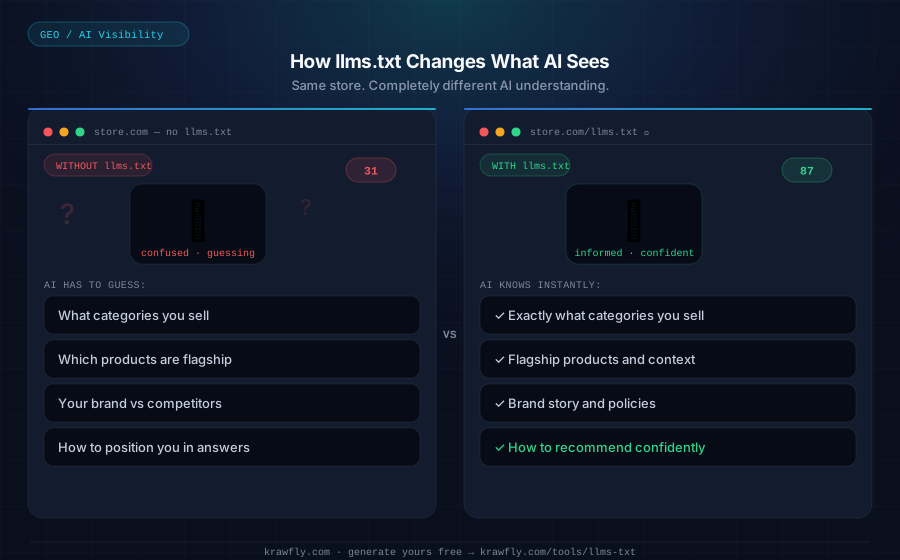
| Without llms.txt | With llms.txt |
|---|---|
| AI guesses your catalog structure | AI knows exactly what you sell |
| Product pages compete for attention | Key pages are explicitly surfaced |
| Generic descriptions leave models guessing | Structured context is easier to retrieve |
| You rely on whatever the model already saw | You publish a map you can update |
The llmstxt.org Specification
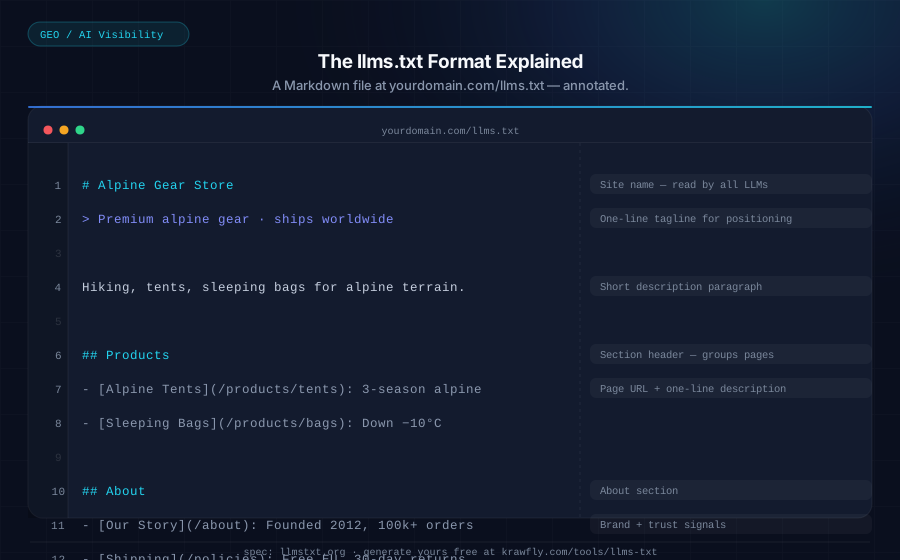
The llmstxt.org specification, proposed by Jeremy Howard, defines the standard format:
# Brand Name
> One-line tagline

Brief description of the site.

## Category Name
- [Page Title](https://example.com/page): one-line description of this page
The file uses Markdown. It starts with the site name, a tagline, a short description, and then sections that group your most important pages with short descriptions of each.
What to Include in Your llms.txt
For an e-commerce store, the most valuable sections are:
- Products — link to key category pages or flagship products, not every SKU
- About — who you are, what you sell, your story
- FAQ or Support — common questions AI models get asked about your brand
- Policies — shipping, returns, guarantees (AI agents cite these when users ask)
Keep it focused. A well-structured 30-line file outperforms a 300-line dump.
How to Create Your llms.txt for Free
You can generate a free llms.txt for any website in seconds using the Krawfly llms.txt Generator. Paste your URL and get a Markdown file following the llmstxt.org proposal.
For Shopify catalogs that also need product signals, schema fixes and citation tracking, start from the Shopify GEO guide.
Frequently Asked Questions
Does llms.txt replace robots.txt?
No. robots.txt controls crawler access. llms.txt provides semantic context for AI models. You need both.
Will ChatGPT read my llms.txt automatically? Not reliably, and not in real time for every session. Some crawlers and agents request it; others ignore it. Treat it as an optional discovery file, not as proof of AI visibility.
How often should I update my llms.txt? Update it when your catalog, positioning, or key pages change significantly. A quarterly review is a good habit.
Is llms.txt free? Yes. It is a plain text file — no extra infrastructure.
Related
- Free llms.txt generator — create the file
- Does llms.txt actually help? — evidence, limits, mistakes
- GEO vs SEO — where the file sits in a catalog strategy
Free Tool · No signup
What's your store's AI Visibility Score?
Paste any store or product URL. Get a score 0–100 with a breakdown of what AI agents can and can't read — in seconds.