
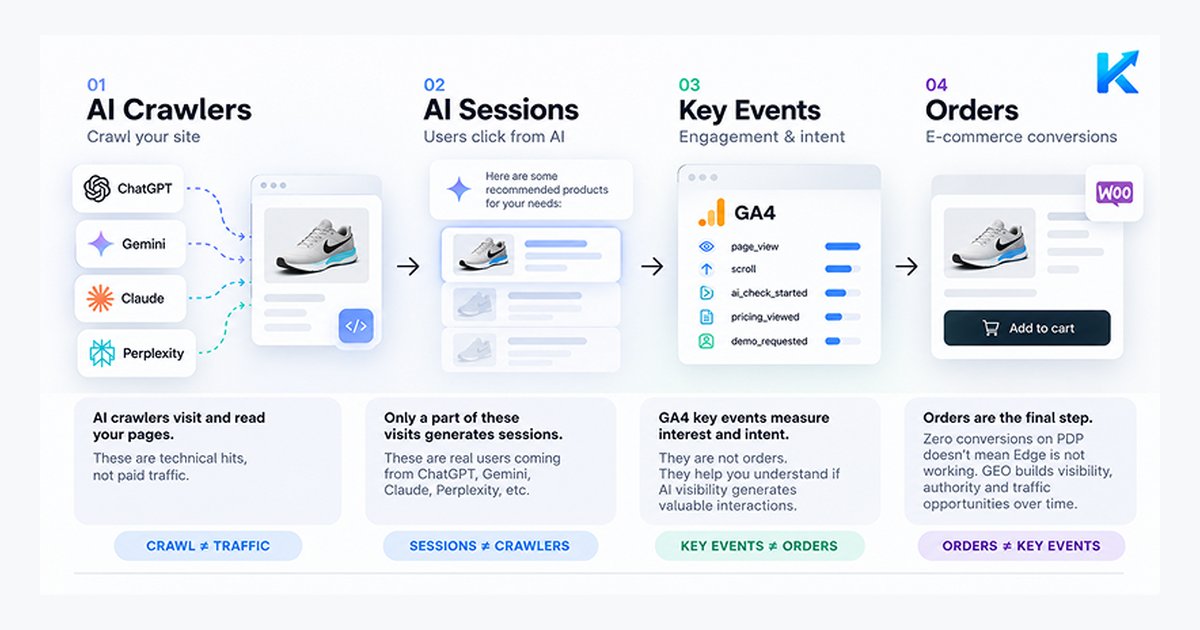
GEO Is Not Advertising: Crawl ≠ Sessions ≠ Orders
AI crawler hits are not paid traffic. GA4 key events are not WooCommerce orders. Zero PDP conversions does not mean Edge failed. How to brief GEO without treating it like ads.
GEO is not a media buy.
If you brief it like Meta or Google Ads — “we spent X, we got Y sessions, therefore Z ROAS” — you will kill good work with the wrong scoreboard.
Edge crawl, ChatGPT citations, GA4 key events, and WooCommerce (or Shopify) orders sit on different layers. Collapsing them into one number is how teams declare “GEO failed” when the only honest answer is “we measured the wrong thing.”
Three Ledgers, Not One Funnel Slide
| Ledger | What it answers | Where it lives |
|---|---|---|
| Crawl / Edge | Can AI bots fetch the page and see the signals we inject? | Edge logs, crawl events |
| Visibility | Do engines cite, mention, or recommend us on money intents? | Citation / Evidence checks |
| On-site outcome | Did someone arrive, engage, convert? | GA4 + store platform |
Treat each ledger as evidence, not as a substitute for the others.
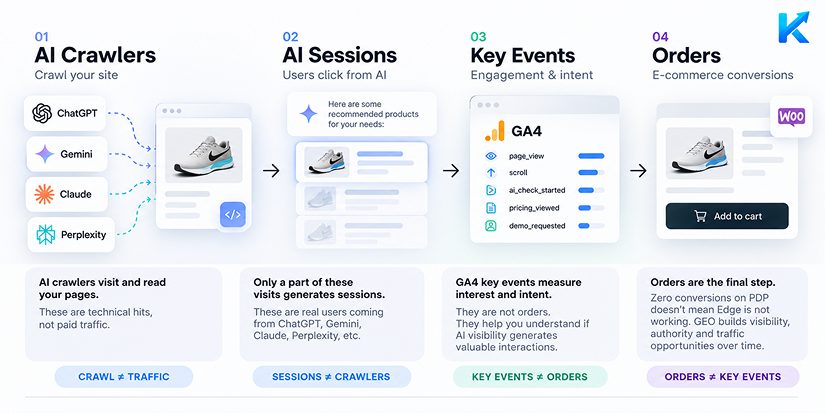
Crawl ≠ Sessions
An AI crawler hitting a PDP is readiness, not demand.
- Crawl says: the page was reachable and (hopefully) readable.
- A session says: a browser arrived with some attribution story.
- Most crawls never become clicks. That is normal.
If Edge shows crawler activity and GA4 AI Assistant is flat, you are not looking at a contradiction. You are looking at two clocks. Pair them with AI Visibility vs AI Traffic — do not force them into one KPI.
Key Event ≠ Order
A GA4 key event is whatever you marked as important — scroll depth, add-to-cart, a custom “AI landing” event. It is not automatically a paid order in WooCommerce or Shopify.
Useful briefing language:
- “Attributed AI sessions moved X% on money intents.”
- “Key events on AI landings are Y vs site baseline.”
- “Platform orders tagged / assisted in this window: Z — with Direct treated as hypothesis, not proof.”
Useless briefing language:
- “GEO ROAS is 4.2×.”
- “Zero AI orders this week → turn Edge off.”
Attribution on AI referrals is already noisy (how to read AI traffic in GA4). Pretending courtroom causality makes the next weekly call worse, not better.
Zero PDP Orders Does Not Mean Edge Failed
Common honest explanations when visibility or crawl looks healthy and revenue looks quiet:
- The answer ended the journey — cited, no click.
- Mentioned, not cited — no link to follow (cited vs mentioned).
- Click leaked into Direct — GA4 never saw a clean AI referrer.
- Wrong intent window — you optimized pages nobody asks AI about this month.
- Landing friction — the visit arrived and bounced before checkout.
None of those are “Edge is broken.” Investigate the chain, then decide. That is AI Impact, not advertising math.
How Agencies Should Brief Clients
- Lead with what moved on which ledger, not a single ROI slide.
- Separate crawl evidence, citation evidence, and session evidence.
- Label Direct / unlabeled traffic as hypothesis.
- Keep Google AI Overviews in Search Console — not in the same chart as ChatGPT referrals (AI Overviews for ecommerce).
Krawfly is built for the left side of that brief (crawl, catalog GEO, citations, Evidence). GA4 and the store own the right side. The job is to put them side by side, not to sell GEO as ads with a prettier UI.
GEO improves the chance you are in the answer.
Ads buy the attention.
Confuse the two, and every quiet week looks like a failed campaign.
Free Tool · No signup
What's your store's AI Visibility Score?
Paste any store or product URL. Get a score 0–100 with a breakdown of what AI agents can and can't read — in seconds.